
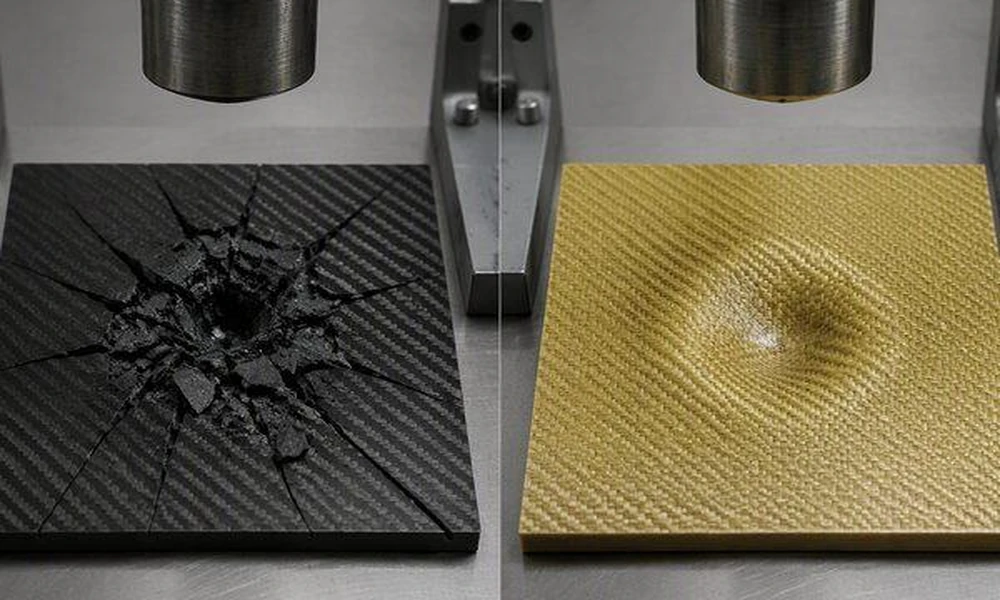
Impact testing tells the real story: how a part fails matters as much as when.
A carbon fiber splitter for a popular chassis might cost $400. The same shape in carbon Kevlar hybrid might cost $550. The math looks obvious until you run it for a full season, at which point the cheaper part has often become the expensive one. Here is how the real numbers behave.
The Price Tag Is Only the First Payment
Raw material cost actually favors carbon. Kevlar fiber runs about $15 to 25 per pound against $10 to 20 for standard carbon, and hybrid layups take longer in the mold because two fiber types have to be placed carefully. So yes, the hybrid part costs more on day one. Nobody disputes that.
The dispute starts on day thirty, when the carbon splitter meets its first parking block.
Failure Is a Line Item
Carbon fiber fails suddenly. One sharp impact and you have a crack, and the crack you can see is often not the whole story. Internal delamination can spread invisibly through the laminate and finish the job weeks later. When a carbon splitter dies, it usually dies completely.
Kevlar-containing parts fail differently. The aramid fibers stretch two to four percent before breaking, so impacts that would crack carbon leave a dent or a scuff instead. The part keeps working, you keep driving, and the replacement budget stays unspent. The carbon Kevlar vs carbon fiber test data quantifies this gap, and it is not small.
The Hidden Costs Nobody Invoices
Replacement parts carry costs that never appear on the price tag:
- Shipping a second splitter, often internationally, with waiting time attached.
- Fitment labor. Paying twice for the same install, or losing a weekend doing it yourself again.
- Missed events. A part that fails on Friday costs you the Saturday you already paid for.
- Alignment and aero balance time, because a new part is never identical to the one you dialed in.
Add those up across one replacement and the $150 price gap is gone. Across two replacements, the hybrid was the budget option all along.
Where the Math Flips
None of this means everything should be hybrid. Parts that live out of harm’s way, roof spoilers, mirror caps, interior trim, rear wings on cars that stay on asphalt, almost never see impact. Paying a toughness premium for a part that will never be hit is its own waste of money. Pure carbon is the right buy there, and the savings are real.
The honest rule: spend hybrid money where the car meets the world, spend carbon money where it does not. If you are budgeting a wider build, the same total-cost thinking applies to bigger decisions. This carbon fiber vs aluminum guide runs the same kind of numbers for structural parts, and the forged carbon vs woven comparison covers the cases where you are paying partly for appearance.
Running Your Own Numbers
You can do this math for your own car in five minutes. Write down what the part costs in each material. Estimate honestly how many times it will take a real hit per year, and what a failure costs you. The part, the shipping, the missed weekend. If one likely failure exceeds the price gap between carbon and hybrid, the hybrid pays for itself in expectation. If the part lives untouched at roof height, the gap is pure savings and carbon wins. The spreadsheet is boring. So is buying the same splitter three times.
A Note on Repair vs Replace
One more cost factor rarely makes it into the spreadsheet: repairability. A scuffed hybrid part can often be sanded, re-cleared, and put back to work for the price of an afternoon. A cracked carbon part is usually done. Structural repairs to carbon laminates are possible but rarely economic on a bolt-on aero part. So the hybrid’s real-world invoice advantage is even wider than the replacement math suggests, because many of its worst days end in repair rather than replacement.
The One-Question Test
Before you order any exterior part, ask one question: how many times will this get hit in a year? If the answer is ‘probably never,’ buy carbon and pocket the difference. If the answer is ‘every time I drive it,’ buy the hybrid once and be done with it. Write the answer down. It is remarkable how often the part we want and the part our driving needs are two different items, and the invoice is the only honest referee in the room.
The expensive part is rarely the one with the higher price. It is the one you buy twice. And if you ever find yourself standing in a garage holding a cracked splitter, remember: the material was not wrong. The match between material and use was wrong. Fix the match, and the math takes care of itself.